AI’s easiest mistakes to catch are the obvious ones, like fabricated statistics, broken links, or unnecessarily wordy paragraphs. Those problems are frustrating, but they tend to announce themselves.
The harder problem is the AI output that looks finished.
This content is often cleanly written. The argument makes sense at first glance, and statistics are in exactly the right place. Maybe there is even a source attached. Nothing immediately feels wrong.
That is precisely where marketers and PR professionals need to get more skeptical.
AI capabilities continue to improve quickly, but reliability is still uneven. Stanford’s 2026 AI Index found that hallucination rates across 26 leading models ranged from 22% to 94%. That margin of error is unacceptable when companies are attaching their names (and reputations) to AI-generated content.
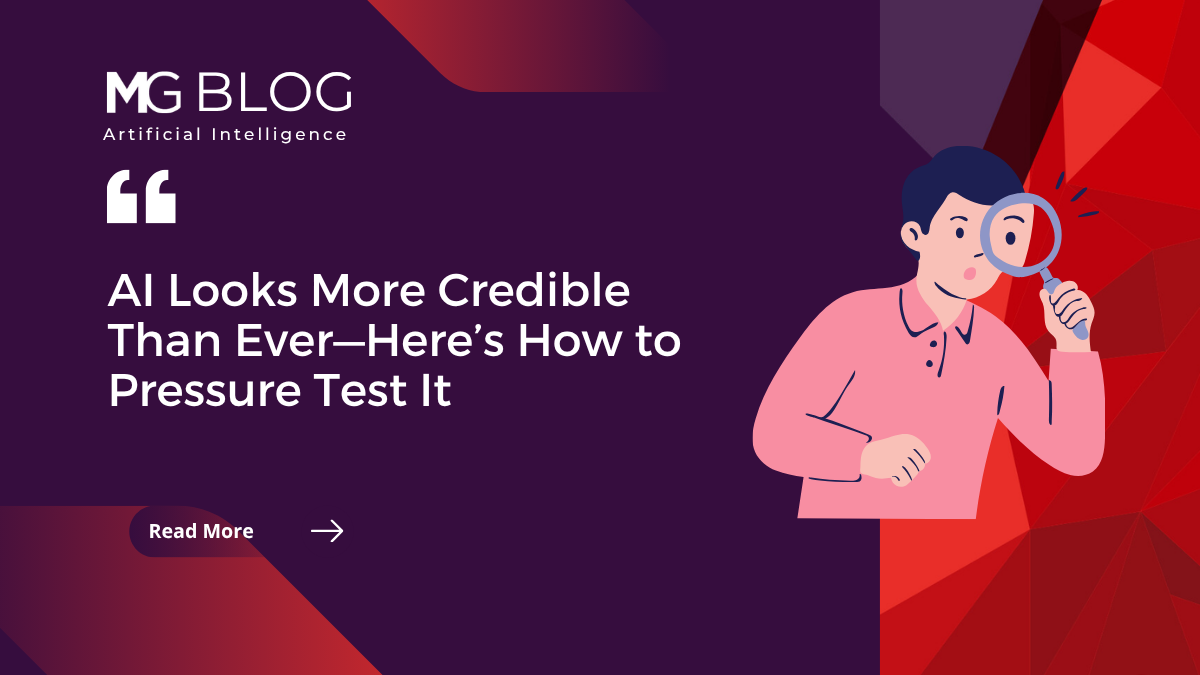
We’ve written before about how communicators can avoid AI slop by improving source material, prompts, and editing. Pressure testing is the next layer. It asks whether the evidence underneath a polished draft actually holds up.
Polish Is Not Proof
In July, four PwC Middle East thought-leadership reports came under scrutiny for fake footnotes, unverifiable data, misattributed claims, and nonexistent sources. These errors weren’t buried in drafts. They appeared in professionally published work.
The incident is a reminder of why communicators can’t take AI-generated content at face value.
Take citations, for example. We often use data to add extra credibility to our argument. However, statistics can be technically accurate but contextually irrelevant when applied to the wrong audience, geography, or timeframe. A limited pilot result can be misrepresented as an enterprise-wide claim. Several true facts can even be combined into a conclusion that none of the original sources actually support.
Simply asking AI for more citations is not enough, either. A May 2026 study published in the Proceedings of Machine Learning Research evaluated 36 AI-generated academic-style documents and found that stricter citation requirements were associated with more invalid or inconsistent references. By contrast, less constrained prompts created a different problem: more unsupported conceptual claims.
When you’re using AI to draft content and pull supporting stats, a source link is only the beginning of verification. Human beings still need to rigorously validate that cited stats are represented accurately and correctly attributed, were published recently, and apply to your target audience.
A Four-Step Pressure Test
As AI becomes part of everyday communications workflows, quality control has to become part of the workflow too. That fits with how we think about AI as a creative accelerator, not a shortcut. The technology can accelerate the work, but strategic accountability stays with us.
A useful pressure test comes down to four steps:
- Source: Identify exactly where the claim originated. Find the underlying report, government dataset, earnings release, research paper, or other primary material whenever possible. Look at who produced it, when it was published, and what evidence it actually represents. AI is great for discovery. However, discovery is not evidence.
- Verify: Open the source and check the claim yourself. Does the statistic actually appear there? Does it refer to the same population and timeframe? Is it describing everyone surveyed or one subgroup? Is a company claim being presented as an independently established fact? The goal is not to prove the link exists. It is to prove the source material supports the sentence you are about to publish.
- Interrogate: Next, challenge the logic. Why did the model choose this evidence? What assumptions connect it to the conclusion? Is important context missing? Is there newer or conflicting information? AI can help surface those questions, but it should not be the sole auditor of its own work.
- Apply: Finally, decide whether the information belongs in the deliverable at all. A claim can be technically accurate and still be misleading, outdated, too narrow, or irrelevant to the argument. This is where human judgment matters most. Google’s recent guidance on AI-generated content reinforces the importance of fact-checking before publication. But verification is only the starting point. Communicators also need to ask whether the information is relevant, reflects the broader context, and genuinely supports the point they’re making.
Better AI Should Raise the Bar
Pressure testing is not about slowing AI-assisted work down. Rather, it is about directing human attention where it matters most.
Let AI summarize the report, organize the notes, and surface possible proof points. Then, check the statistics that your client or media might challenge. Read the methodology carrying the argument. Make sure the compelling example actually proves what you are saying it proves.
AI can give communicators more bandwidth. It cannot own the consequences of what goes out the door.
The better these tools become at producing work that looks finished, the more important it becomes to know when the work actually is.
Want to build AI into your communications workflow without lowering the bar on quality? Connect with Merritt Group to talk about how we’re helping teams use AI more strategically, efficiently, and responsibly.