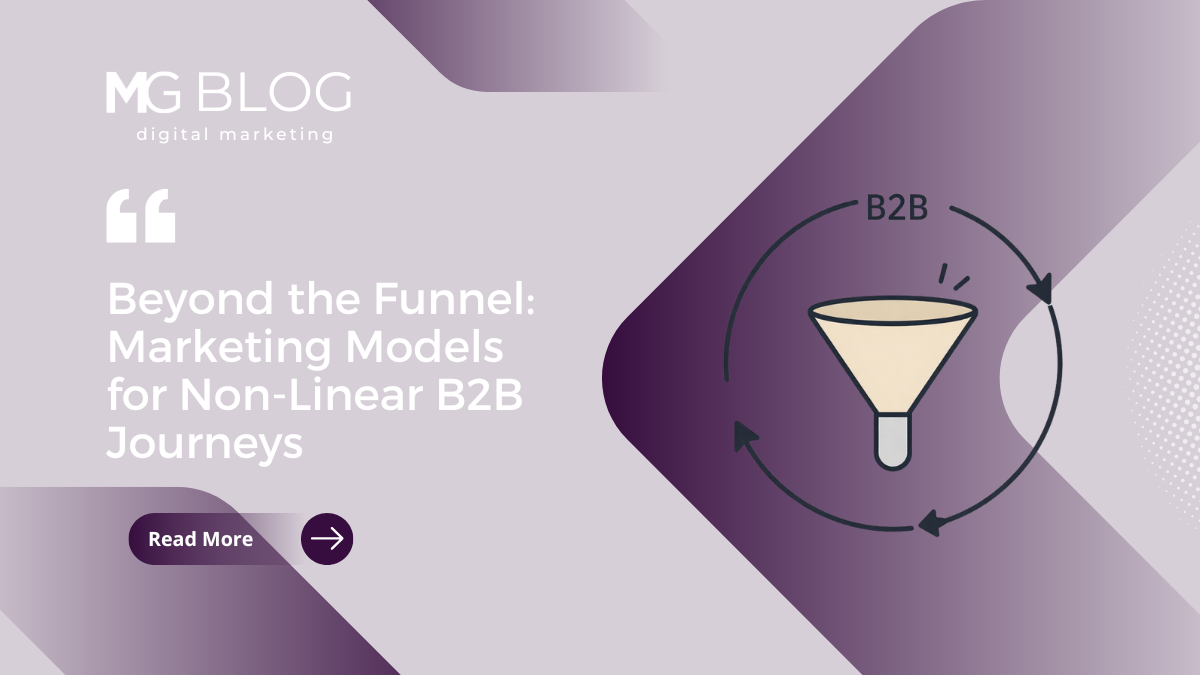
In B2B marketing, the traditional funnel has long been used as the gold standard for mapping the buyer’s path. But today’s B2B buyer journey rarely follows a straight line. Buyers move fluidly between awareness, consideration, and decision, looping back, seeking new validation, and engaging on their own timelines. For modern marketers, clinging to the linear B2B marketing funnel risks oversimplifying reality and missing critical opportunities to influence decision-making.
Instead, organizations must rethink their B2B marketing strategy with models that reflect how real people research, evaluate, and buy in a complex digital environment.
Why the Funnel Falls Short
The traditional funnel assumes that prospects flow neatly from awareness to conversion. But in practice, today’s buyers:
- Enter the journey at multiple points, sometimes skipping “awareness” entirely.
- Rely on peer recommendations, dark social channels, and communities outside your owned touchpoints.
- Bounce between online research, vendor demos, and third-party content before looping back to reconsider options.
As discussed on our podcast, the modern B2B buyer’s path is fractured, influenced by countless invisible touchpoints. Measuring success or planning engagement requires a more flexible, dynamic model.
Alternative Models for the B2B Buyer Journey
Forward-thinking marketers are adopting new frameworks to capture these realities:
1. The Flywheel Model
Popularized by HubSpot, the flywheel emphasizes momentum rather than linear progression. Instead of dropping customers out of the funnel after conversion, the flywheel highlights how engagement, support, and customer success generate retention and advocacy. As GTM Impact notes, this continuous loop creates compounding value through customer growth and loyalty.
2. The Loop Model
A variation of the flywheel, the loop acknowledges that buyers rarely proceed in a single direction. They revisit earlier stages, reading more content, comparing competitors, or re-engaging after budget cycles shift. This framework encourages marketers to maintain persistent visibility across every stage, reinforcing trust and credibility at each return.
3. The Content Ecosystem Approach
As MarTech explains, going “beyond the funnel” requires moving away from content campaigns designed for linear stages and toward ecosystems built around buyer needs . The idea: instead of pushing leads down a path, provide interlinked, always-on resources that help buyers self-navigate on their terms.
What This Means for Your B2B Marketing Strategy
Shifting beyond the funnel isn’t about discarding structure, it’s about rethinking how you engage across non-linear paths. To adapt your B2B marketing strategy:
- Build modular content: Create assets that serve multiple purposes (e.g., a thought-leadership whitepaper that can be repurposed into video clips, blog series, and LinkedIn posts).
- Invest in trust drivers: Case studies, third-party validations, and peer-driven testimonials carry more influence than brand-first messaging.
- Embrace data loops: Use intent data, behavioral signals, and ongoing engagement metrics to refine campaigns dynamically rather than sticking to rigid stages.
- Align marketing and sales: Ensure both teams share a unified view of buyer behavior. When alignment is strong, messaging resonates consistently and conversion accelerates.
The Bottom Line: Beyond Funnels, Toward Momentum
Linear funnels oversimplify what today’s B2B buyers actually do. Non-linear models, flywheels, loops, and content ecosystems, offer a more realistic and effective lens for engaging prospects. They acknowledge that buyers move forward, backward, and sideways before making a decision.
At Merritt Group, we help clients navigate these fractured buyer journeys with integrated strategies that prioritize momentum, trust, and measurable outcomes. Explore our perspective on today’s non-linear customer journey to see how we can help you go beyond the funnel and accelerate growth.